



“I felt like I’d break if a child on the street bumped into me”


"I felt like I’d break if a child on the street bumped into me"
Emer Clarke
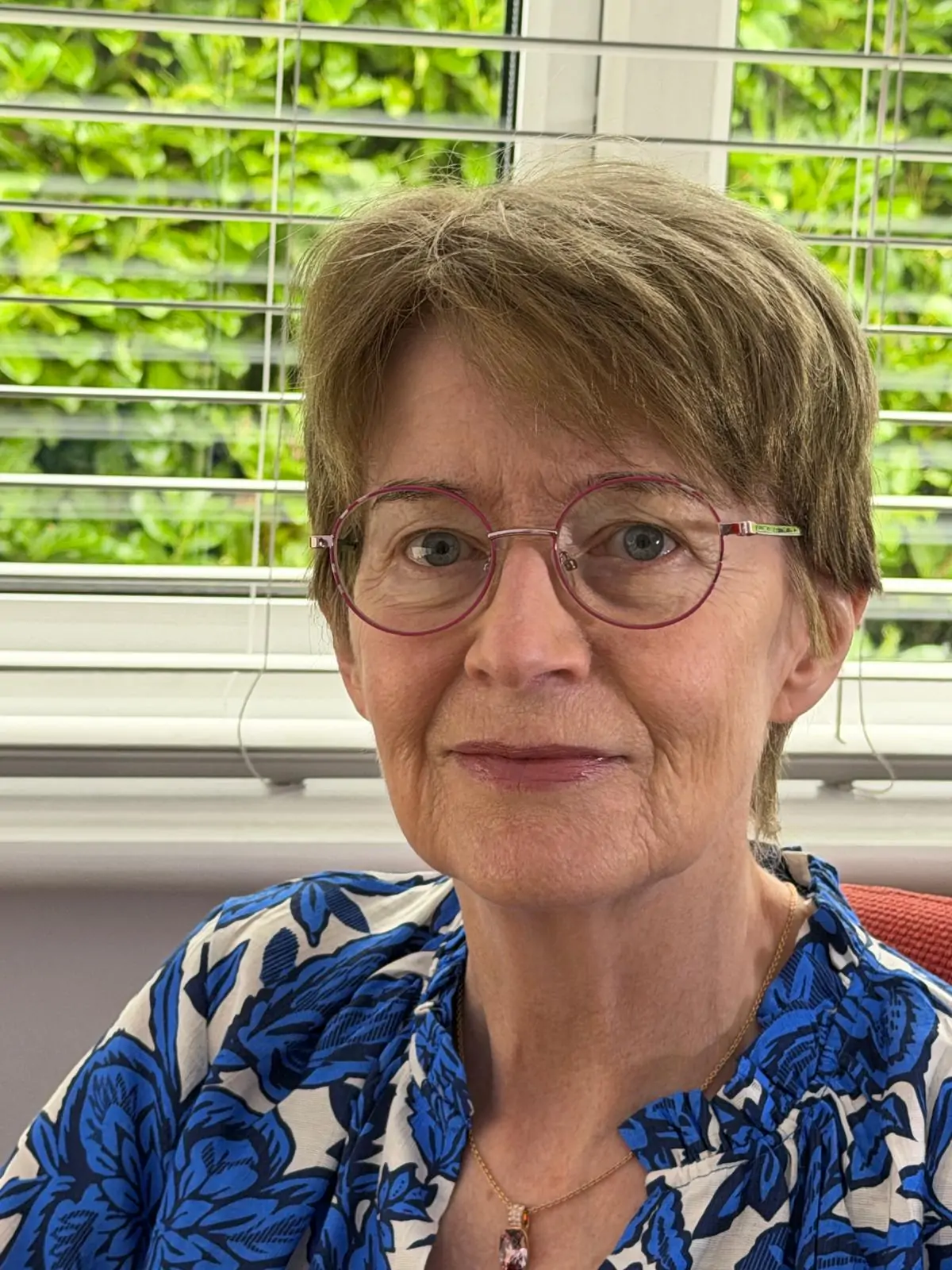
Emer Clarke, 65, was losing height, experiencing bone fractures and living with severe pain yet, for years, there was no clear explanation for what was happening. Things only began to improve when she met a rheumatologist who took the time to listen and understand her experience. Thankfully, with the right treatment and lifestyle measures, including strengthening exercises, she is now feeling more confident and positive about her quality of life.
The first thing Emer noticed was that she was getting smaller. It was seemingly minor things at first. She would reach into a kitchen cupboard for a plate and find that it was suddenly just out of reach or knock a plate off the side of a countertop because it felt suddenly higher than it used to be. The proportions of her body also seemed to be changing, and she noticed her clothes were not fitting in the usual way. “The waist of my jeans was suddenly much higher up, moving towards my chest while blouses previously sitting at my waist were now siting lower down over my hips,” she says. “My torso had shrunk right down.”
She also noticed that she seemed smaller than people around her. “How am I becoming smaller, even though I’m still relatively young?” she remembers thinking. She had already experienced a compression fracture in her vertebra in 2000 and, as a result, developed ‘kyphosis’, a forward curvature of the spine. A DEXA scan carried out around that time had shown only mild osteopenia, so she didn’t spend too much time dwelling on it.
Feeling fragile
Less than ten years later, Emer’s health began to worsen. Between 2009 and 2012, she describes the feeling of her bones becoming painful, like the contractions she felt when giving birth. At that time, even a slight bump against something could leave her in pain for months. Reaching to close a window, she would feel a rib ‘go’, meaning it was potentially fractured. “I had a fear of anyone knocking into me,” she says. “I felt like I’d break if someone on the street bumped into me. If I saw any children rushing towards me, I’d lean against a wall because I felt so fragile.”
By October 2012, her life had become dominated by pain, and she entered what she describes as ‘a very dark time’. She went into hospital to see a pain-management consultant and received injections into her spine. The following morning, she was advised to do some light exercises at home. But neither herself nor the pain management consultant knew just how fragile her spine had become. When Emer flexed her back, six levels of her upper thoracic spine, including associated ribs, fractured. The pain was excruciating.
Living with unbearable pain
The following weeks and months were unbearable. She could neither stand nor lie down. When she tried to get out of bed, the shock of taking her body weight felt overwhelming, and she would have to collapse back down onto the mattress. Her breathing also became affected and she barely slept. “In fact, I became very ill through a lack of sleep,” she says. She begged for painkillers, but one doctor only offered her three tablets, as he said they were highly addictive. I thought, ‘If you knew me well enough, you know that wouldn’t become an issue.” Instead, she ended up in A&E the following day only to be sent home, this time with a prescription for stronger painkillers.
Still, the months went on without any clear answer or explanation for her pain, which she had now endured for over four months. Her breathing difficulties were put down to a reaction to the painkillers. Her GP suggested it could be fibromyalgia and described her as ‘in the top three’ of patients in the practice with such severe symptoms. But Emer knew there was something else happening.
Finally, someone listened
“I was sure, myself, that there was something mechanical going on.” Eventually, her husband went with her to the GP. It took that event to finally turn the tide and for someone to really listen. “My husband said, ‘Look, there’s something seriously wrong here with Emer. It’s taking her forty minutes to get off the bed. This is not right. You have to do something.’”
In January 2013, at Emer’s request she had an updated DEXA scan. Although a standard DEXA scan primarily measures bone density rather than looking for fractures, the spine images obtained during the scan can sometimes reveal vertebral fractures and, in Emer’s case, this mean that the radiologist saw fractures straight away and noticed that change in her height. She had lost 5¼ cms. In fact, a later measurement brought the total loss to around 6½ cms (just over 2.5 inches). “It may not look like a lot on a ruler,” Emer says. “But it’s a lot when it’s your body and your torso is shrinking.” Emer’s DEXA scan was still in the osteopenia range at this stage, again highlighting that the DEXA scan alone is not always revealing the full picture of what may be going on with our bones.
Finding a way forward
A rheumatologist became involved, along with neurosurgical and orthopaedic specialists. And so Emer began treatment for osteoporosis. But there was still a difficult road ahead. She continued to have fractures and, in 2014, underwent two spinal procedures. Kyphoplasty [a procedure that stabilises collapsed bone with medical cement] was performed on eight vertebrae to stabilise the affected areas. Emer also began treatment with teriparatide, a daily injectable osteoporosis medicine that stimulates bone formation.
Within approximately one month of treatment, Emer began to notice a change. The terrible spasms and contractions of pain that had become such a feature of her life began to lessen. The difference was enormous. She was left with what she describes as a much more manageable level of pain.
Rebuilding confidence in her body
“I suddenly started to build confidence in not being afraid to move and break bones.” Before her treatment, Emer remembers walking down the corridor with two sticks. “I even remember flinging them against the wall in frustration,” she says, with sadness, as the memory floods her once again. “I remember thinking, ‘There’s something really wrong with me, but doesn’t anybody believe me?’”
At night, she found some small refuge from having to pretend everything was all right. “The night is mine,” she remembers thinking. “I won’t have to lie that I’m okay when I’m really not okay.” Her son was only 10 when the issues began, and she worried about what he was seeing and hearing (in terms of her laboured breathing). “I carried terrible guilt at the time,” she says. “He had to witness me in terrible pain, and I worried about the impact of that.”
At one point, she began to prepare for the possibility that this was simply how her life would end. She went so far as to give jewellery away because, she says, she was “…almost getting ready to go”.
From surviving to living
It was her rheumatologist, she believes, who finally changed the direction of her life. “He actually listened to me,” she says, “I feel such gratitude to that man. In a way, I owe him my life. Like any chronic, long-term condition, you don’t ever fully recover from this, but you can learn to manage it.”
Emer has thrived since continuing with osteoporosis treatment and specialist monitoring. In addition to medication that actively stimulates the formation of new bone tissue, she has also been on regular ‘bone strengthening’ medication. Movement has become another crucial part of the jigsaw. For a long time, walking was the only exercise she could manage, and even that was difficult. Before all this happened, family holidays had involved trekking. But, in 2012, she could barely walk without two sticks.
The importance of movement
As her mobility improved, Emer began introducing light weights and recently joined an Arthritis Ireland strength-based programme, led by a chartered physiotherapist. She has learned which movements feel safe and how to distinguish muscular discomfort from pain that could indicate a spinal problem. “I will never do sit-ups, for instance,” she says. “But I can do push-ups.” She adapts exercises and uses lighter weights when needed. “I find exercise makes me feel so good and I’m so delighted and grateful to be able to do it.”
She is also careful about what she eats and takes supplements as part of her own approach to managing her bone health. She pays much more attention to calcium and vitamin D and has increased calcium-rich foods in her diet. Her treatment has continued for around a decade now. She is currently on a monitored ‘drug holiday’, which means a break from regular medication. However, she recently experienced an episode that felt similar to one of her previous fractures, so vigilance is always top of her mind, and the healthcare team that oversee her care.
Becoming a voice for others
She has become somewhat of an advocate for people who may not understand their osteoporosis risk fully. “Now, if I come across anybody who has had a fracture, I always ask, ‘did you suffer a trauma?’” she says. “If they answer, ‘No, not really, I just went over awkwardly on the footpath,’ then I would always say to them, ‘Look, go have a DEXA and, as well as that, start taking a record of your height as a DEXA isn’t everything.”
Her advice is rooted in experience, and in a history of feeling that she was largely ignored. “For anyone tagged with the label of fibromyalgia, particularly because they felt I didn’t fit any other label, it can have dangerous results. I wasn’t listened to. Part of me doesn’t want to go blaming anyone, because they are just working with the scans they’re given. But you have to ask about that, like, why didn’t the scans show anything when there was clearly something there? Why are they so limited?”
Enjoying life and feeling grateful
Although Emer still experiences ongoing micro-fractures in her spine, and she still experiences pain, life is still good. Today’s pain is a very different type of pain and, indeed, she lives a very different life from the one she once thought she would have. “I’m 65 now,” she says. “You would expect to be having a bit of pain here and there. Most people do at this age. But I can deal with this pain, having experienced what I have in the past.”
Emer works for herself and exercises regularly. She gets to enjoy precious time with her family, including her son who she says, “No longer has to witness me in such severe pain.” Her husband too, who once had to persuade doctors that something was seriously wrong with his wife, can now enjoy how well she is doing. “My family life is so much better now,” she says. “The level of confidence that I got back after my treatment, and after finally meeting someone [her rheumatologist] who was ready to listen,” she says, “was that my body would not let me down anymore, and that I could finally learn to trust it again.”
Losing height? It might be your bones, not just your age
Emer is particularly keen that people understand that osteoporosis can be more complicated than a single number on a scan. A DEXA measures bone mineral density, while clinicians consider a person’s fracture history and other risk factors when assessing fracture risk. Emer wishes she had understood earlier that losing height and developing changes in posture can be signs of vertebral fractures associated with osteoporosis. Other possible signs include a stooped or hunched posture and sudden back pain, although vertebral fractures can evenoccur without noticeable symptoms.
For further information
Visit the osteoporosis page of our website.
Read our booklet, Living with Osteoporosis.
Watch our video with Consultant Rheumatologist, Dr. Abuelmagd Abdalla. https://youtu.be/UsQZKkNgLAs
If you have arthritis, or a related condition such as osteoporosis, you are eligible to join one of the physical activity classes run by Arthritis Ireland. Visit our physical activity page, or alternatively email: [email protected] or phone: 0818 252 846 for more information. You can also also contact The Irish Osteoporosis Society (www.irishosteoporosis.ie; Email: [email protected]; Phone: (01) 637 5050.
resources
Related Resources
 ‘But you look fine’: the challenges of living with an invisible illness
 Arthritis Ireland’s osteoporosis awareness campaign
 Osteoporosis: 6 myths that could put your bones at risk
 Living with Osteoporosis with Dr Abuelmagd Abdalla
 Living with Osteoporosis
 Farming and arthritis
 Arthritis Ireland National Raffle 2026
 World Arthritis Day 2026
Support Our Mission
Your donation helps us provide essential support, fund research, and improve the lives of those living with arthritis. Every contribution matters — help us make a difference today.
